
 Jan
05
Jan
05
Trickle-Down Theory in Sportswear – How Innovation in Sportswear Trickles Down to Consumers?
- 5 January 2026
- 0 Comment(s)
Before a new shoe hits the shelves or a fresh fabric becomes the next big trend, it begins somewhere simple and often unseen. A runner tests it on a quiet morning track, a lifter tries it during a tough training session, a small lab studies how it performs, even when the prototype looks nothing like the final product.
Whether it’s a new shoe or an innovative fabric, every trend starts with an athlete experimenting with unusual ideas. Every sportswear innovation exists in a small, exclusive circle long before it reaches your nearby store or appears online. That slow journey, called trickle-down theory in sportswear, built on testing, tweaking, and real athletic feedback, is what eventually shapes the gear people rely on today.
What is the Trickle-Down Theory?
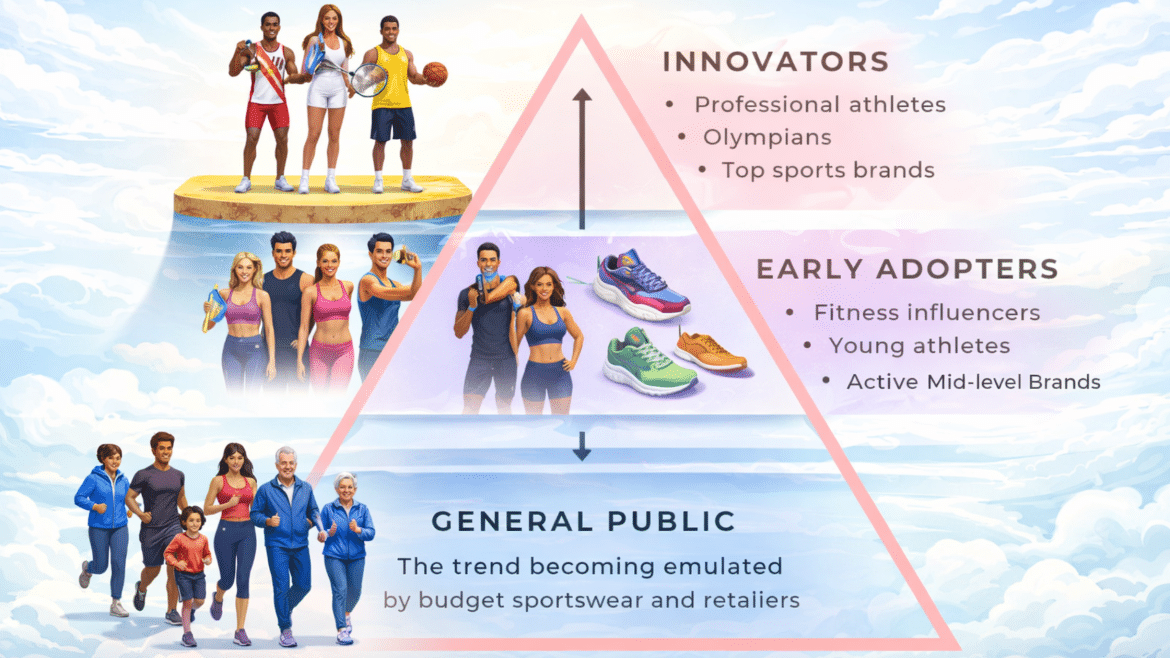
Trickle-Down Theory means a new sportswear innovation always reaches the top athletes first. They are the ones who test the roughest, earliest versions of any new technology. These prototypes go through real pressure, speed drills, heavy lifts, long runs, and everything in between. Their performance shows what truly works and what fails.
In that place, designers start modelling the concept into the application that is more feasible, whereas engineers optimize the substances to make them feel more comfortable, durable, and work the way they are required by athletes. New versions are tested again, adjusted, and tested once more. Gradually, these advancements trickle down to professional athletes and then amateurs who are devoted to their sport, and eventually down to ordinary people who just desire comfortable and reliable sportswear.
Key Takeaways from Trickle-Down Theory in Sportswear
Innovation & Technology Integration
Athletes wearing shoes with unfamiliar foam patterns, tops made from fabrics that didn’t exist a year ago, and compression gear designed with mapped pressure zones. All motions are monitored, all steps are counted, and not to sell something but to make it better.
These tests shape advancements like:
- lighter cushioning
- moisture control technology
- improved energy return
- seamless construction
- advanced grip patterns
What begins as high-level experimentation eventually enters everyday wardrobes. A new material that reduces friction for a sprinter might become the inner lining of a walking shoe. A stability feature meant for long-distance athletes could later support someone jogging for fitness.
Latest Fashion Adoption
What’s worn on the track often ends up on the street. Not because athletes chase trends, but because performance designs tend to look sharp, intentional, streamlined. Eventually, people notice.
- A training shoe turns into a lifestyle sneaker.
- A warm-up jacket becomes a streetwear staple.
- A running tight becomes weekend attire.
Take the Adidas AlphaBoost as an example. Before it became a popular consumer option, it was a test shoe, designed for stability and responsiveness under high impact. Athletes evaluated its cushioning, designers adjusted the support, and engineers improved the bounce profile.
Months afterwards, the refined version was being worn by ordinary runners, non-athletes, and everyday exercisers. The fact that performance gear is turned into comfort that can be worn on a daily basis is precisely how the trickle-down theory in sportswear goes.
Mass Market Proliferation
Once testing ends and designs stabilize, the gear begins its wider release. Production increases, prices become reasonable, and marketing expands. Suddenly, the same technology, once limited to a handful of athletes, sits on shelves across cities.
This is the point where innovation truly becomes accessible. When everyone, regardless of skill level, benefits from improvements that began far from the public eye.
Sustainability
Sustainability follows the same flow. Early experiments often appear in small, athlete-focused batches, recycled fibers, plant-based materials, and reduced-water dyes.
Athletes test them first, revealing durability issues or comfort limitations, and adjustments follow. Only after repeated refinement do these eco-friendly materials reach mass production. Today, many sustainable pieces owe their existence to these early, lesser-known athlete trials.
Personalization
Personalized sportswear also began at the elite level. Athletes long received:
- Customized fits
- Tailored compression
- Individualized support zones
As technology improved, these features moved outward. Now consumers can access options like 3D-scanned footwear, adjustable cushioning, personalized insoles, adaptable fabric structures, and custom sportswear from renowned brands like TD Sportswear.
The other instance of the trickle-down theory in the sportswear industry silently influences daily decisions.
The Bottom Line
Before innovation becomes mainstream, it lives in the hands and on the bodies of athletes. They are the testers, the stress points, the real-world validators. Their daily routines determine which ideas survive and which disappear.
Consumers experience the final, polished results. Shoes that cushion better, fabrics that dry faster, designs that simply feel more natural. Most of these improvements began long before the public saw them.
And brands that understand this cycle, brands like TD Sportswear, which adapt advanced concepts into practical and custom sportswear, help shorten the distance between athlete innovation and everyday comfort.
Frequently Asked Questions About Trickle-Down Theory in Sportswear
How does innovation in sportswear trickle down to consumers?
It begins with athletes testing early prototypes. Designers refine the product based on performance results. Once the technology proves reliable, brands simplify production and release it gradually, eventually making the improved version accessible to everyday consumers.
Why do sportswear brands test products on elite athletes first?
Elite athletes put extreme pressure on gear, revealing weaknesses quickly. Their training intensity helps designers understand durability, comfort, and performance limits, allowing them to perfect the product long before it reaches regular users.
How do professional athletes influence sportswear innovation?
Their movement, feedback, and performance data guide designers. Even small comments about comfort, friction, or stability lead to improvements in materials, fit, and support, shaping the final version that consumers eventually use.
When do elite sportswear technologies reach consumers?
It depends on production complexity. Some innovations appear within months if easy to scale, while others take years. Once manufacturing becomes efficient and costs drop, the technology becomes available to the general market.